
Support worker progress notes: what to ask for, with examples
What to ask your support workers to write after every visit, with progress notes examples, levels of help, and what to record when something goes wrong.
Updated . General information, not advice: check with your plan manager, support coordinator, doctor or therapist about your situation.
When you can't be there, a short note from your support worker is how you know what happened. Did they eat? Was it a good day? Did anything go wrong? And when your plan reassessment comes around, those same notes can become the record of the support that was delivered and how things changed.
But "how did it go?" usually gets "good, thanks", and a blank notebook usually stays blank. This guide covers what to ask your workers for in their care notes (also called progress notes), how to make the notes useful, and how to keep them easy enough that they actually get written.
Why care notes matter to a family
Good notes do three jobs at once:
- Peace of mind today. You can see how the day went without calling or texting the worker.
- Consistency across the team. When several workers share the week, notes tell the next person what happened yesterday.
- Evidence for later. A year of short, dated notes shows the supports that were delivered, how often, and what changed, which can help you show what's needed at a plan reassessment.
Notes are also how you answer the question most families carry around: "How do I know it's actually being done?"
The 5 questions to ask after every visit
The most useful notes come from a few short questions, asked the same way every time, rather than a blank page. These five are based on the check-ins families and therapists most often set up for their workers:
- How did today go? Good or not so good, plus a line about why.
- Were there any incidents to report? Yes or no. If yes, the details go in an incident record (see below).
- How did they go with tasks around the house? On their own, with prompts, or with help.
- What did they eat and drink? Ate well, ate some, or ate very little.
- How was their mood, and were they able to manage it? Yes, with support, or no, plus what helped.
Pick the questions that matter for the person you support, and leave out the rest. If communication is a goal, add "Were they able to communicate with others?" If mobility is the focus, ask about transfers or walking. Five questions that get answered every time are worth more than fifteen that get skipped.
Levels of help: on their own, with prompts, with help
The single most useful habit is asking for the level of help, not just whether something happened.
| Level | What it means | Example |
|---|---|---|
| On their own | Did it without help or reminders | "Made her own sandwich." |
| With prompts | Did it, with reminders or verbal cues | "Showered. Needed reminders to wash her hair." |
| With help | Needed hands-on help | "Needed help with buttons and shoelaces." |
"Showered" tells you it happened. "Showered: with help" in March and "Showered: with prompts" in September tells you something has changed. That kind of change, recorded over months, can be far more convincing at a plan reassessment than a memory of "she's doing better".
The same idea works the other way. If someone needs more help than they used to, dated notes show when it started and how often it happens.
Progress notes examples: a good note and a vague note
A good note is short, specific and factual. It says what happened, not how the worker felt about it.
| Vague note | Useful note |
|---|---|
| "Good day." | "Good day. Walked to the park and back with one rest. Ate all of lunch." |
| "Bit upset in the afternoon." | "Upset at 3pm when the bus was late. Headphones and a quiet walk helped. Settled in about 15 minutes." |
| "Did some cooking." | "Made toast and a cup of tea with prompts. Needed a reminder to turn the kettle off." |
You don't need workers to write more. You need them to write the specific thing: what, when, how much help, and what worked.
Incidents: what to record the same day
In an emergency, call 000 first. If something goes wrong, such as a fall, an injury, a medication error or a serious behaviour, ask the worker to write it down before they leave:
- When: the date and time.
- What happened: the facts, in order.
- What they did: first aid, who they called, what they changed.
- Who they told: you, a family member, a nurse or doctor, or emergency services.
Notes written on the day are much more accurate than ones pieced together later, and they're what you'll want if a therapist, doctor or planner asks. If your worker is employed through a registered provider, the provider will also have its own incident procedures, so ask them how they report incidents to you.
Making it easy for workers
Most workers are happy to write notes. What stops them is a long form, an unclear question, or not knowing where the notes go.
- Keep it short. Five questions, most answered with a tap or a word, and one line of free text.
- Ask the same questions every time, so it becomes a habit and the answers can be compared.
- Give answer options, such as "on their own, with prompts, with help", so workers don't have to decide how to phrase things.
- Make it one place. Notes scattered across a notebook, texts and emails are hard to find and easy to lose.
- Say thank you, and use them. When workers see that you read the notes and act on them, they keep writing them.
Where the notes live
There are three common options, and each works for some families:
- A notebook in the home. Simple and free. Hard to read when you're not home, and easy to lose.
- A group chat. Fast, and you see notes straight away. Months of notes become hard to search, and important ones get buried.
- A care app. The same questions after every visit, answered on the worker's phone, and kept as a dated record.
Maslow is one of these apps. We digitise care plans and make them easy to share with support workers, and the check-ins in this guide are built in: your team answers them on their phones, every answer is dated and shows who recorded it, and you can export the history when your plan review comes around.
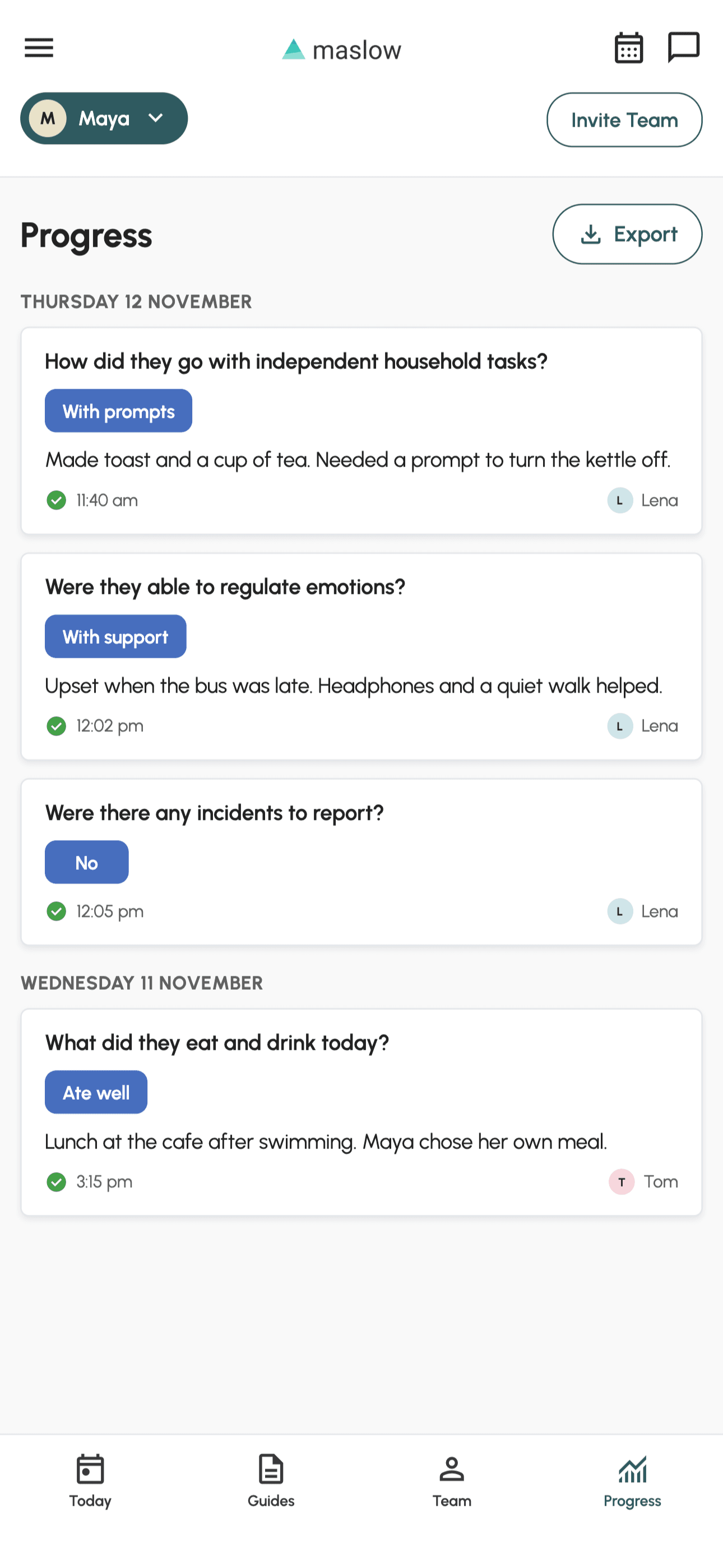
Whichever you choose, the habit matters more than the tool.
Where to start this week
- Pick three questions from the list above that matter most for the person you support.
- Ask every worker to answer them after every visit, with the level of help for one key task.
- Read the notes weekly, and thank the workers who write them.
For the bigger picture, from briefing new workers to handovers, read our guide on how to manage your own team of NDIS support workers. If you self-manage, see how Maslow works for self-managed teams.